Outsource Payroll Services: Key Benefits for Your Business
Key Highlights
Payroll outsourcing helps reduce admin pressure and gives your team more time for growth.
A skilled payroll provider improves payroll accuracy through automation and expert review.
Better payroll management can lower the chance of tax filing mistakes and financial penalties.
Many businesses choose outsourcing for cost savings, stronger compliance support, and simpler reporting.
Timely, accurate pay can improve employee satisfaction and create a better employee experience.
The right provider also supports data security, benefits coordination, and smoother payroll operations.
Introduction
Many business owners start with in-house payroll services, then realize how quickly payroll outsourcing becomes a practical option. Payroll is not just about paying people. It also includes tax filing, employee records, deductions, and ongoing compliance work. As businesses grow, these tasks take up valuable time and increase the risk of errors. Outsourcing can lighten that load, improve accuracy, and help you focus on running the business. Let’s start with what outsourced payroll really means.
What Are Outsource Payroll Services?
Outsource payroll services means hiring an external company to handle some or all payroll processing for your business. Instead of relying only on your internal team or payroll department, you use a payroll bureau or other service providers to manage payroll functions such as wage calculations, data entry, payroll administration, direct payments, and payroll records. Many professional payroll services also use payroll software to organize employee data, payroll data, and employee records across each pay cycle.
In practice, an outsourced payroll service can support payroll management, employee benefits, tax filing, and routine payroll tasks while lowering the risk of errors. Payroll experts often provide expert support, stronger payroll solutions, and peace of mind for business owners with any number of employees. This helps your payroll team spend less time on payroll responsibilities and more time on strategic initiatives tied to business growth and employee experience. To understand the value better, look at the main service features first.
Key Features of Payroll Outsourcing Services
A good payroll provider usually offers much more than basic pay runs. Professional payroll services are designed to support payroll operations, improve payroll accuracy, and reduce pressure on your payroll department. That matters for small businesses and growing teams alike.
Common payroll functions often include the following:
payroll software for routine payroll tasks and smoother payroll management
employee records and payroll records stored in one secure system
compliance monitoring to support payroll responsibilities each pay cycle
employee benefits coordination for a better employee experience
payroll experts who review the payroll process and lower risk of errors
The right provider combines expert support, data security, and practical payroll solutions that create peace of mind. Many payroll experts also help free up time for strategic initiatives that support business growth, employee satisfaction, and better use of payroll data. The next step is choosing the type of provider that fits your business.
Types of Payroll Outsourcing Providers
Not every payroll provider works the same way. Some business owners need a basic payroll bureau for recurring payroll tasks, while others want a payroll services company that supports payroll administration, tax work, reporting, and employee benefits. Your ideal outsourced payroll provider depends on your payroll process, internal team capacity, and business goals.
Provider type | Best fit | Typical support |
|---|---|---|
Payroll bureau | Businesses needing core payroll services | Payroll processing, payroll records, standard payroll tasks |
Full-service payroll services company | Companies wanting broad payroll management | Tax filing, payroll operations, employee benefits, reporting |
Technology-led outsourced payroll service | Teams focused on payroll software and visibility | Payroll data access, automation, self-service tools |
The right choice helps reduce risk of errors and supports business growth. Payroll experts can also improve payroll functions, align employee data with payroll software, and take work off your payroll department so your payroll team can focus on strategic initiatives. Now let’s look at why more companies make this move.
Why Businesses Should Outsource Payroll
For many companies, payroll outsourcing solves a simple problem: payroll takes too much valuable time. Payroll tasks such as data entry, wage calculations, employee records updates, and tax work can pull attention away from sales, service, and business growth. This affects small businesses especially, but larger teams feel it too.
At the same time, a payroll provider can improve payroll accuracy, reduce the risk of errors, and create peace of mind across each pay cycle. Better payroll management often leads to cost savings, fewer errors, stronger employee satisfaction, and more support for employee benefits. The next sections break these gains into operational and financial terms.
Operational Benefits (Time, Efficiency & Accuracy)
The biggest day-to-day advantage of payroll outsourcing is efficiency. A payroll provider takes over repetitive payroll tasks, which means your payroll team spends less time on manual data entry and more time on work that moves the business forward. That shift matters when payroll responsibilities keep piling up.
Key operational gains include:
faster payroll operations across every pay cycle
better payroll accuracy through automation and expert review
fewer errors in wage calculations and employee records
more useful payroll solutions for small businesses with lean teams
improved employee satisfaction when pay is timely and correct
Just as important, payroll software and payroll experts help your payroll department keep employee data organized and consistent. Whether you use a payroll bureau or a full payroll services company, a smoother payroll process can save valuable time and improve payroll management without expanding internal headcount. Cost is the next major reason businesses outsource.
Financial Impact & Cost Savings
Payroll outsourcing often creates cost savings in ways that are easy to miss at first. The monthly fee matters, but so does the time your payroll department spends on calculations, reporting, corrections, and follow-up. For many business owners, the real cost is the drain on valuable time and the chance of avoidable mistakes.
Financial value often comes from:
fewer errors in wage calculations and payroll records
lower exposure to financial penalties tied to filing or payment mistakes
reduced need for extra payroll software or added payroll team hours
more time for strategic initiatives instead of routine payroll tasks
A payroll provider or payroll bureau can also make costs more predictable. Rather than stretching your internal payroll functions, you get payroll services and payroll solutions that scale more easily. For small businesses, that balance between service fees and avoided problems often makes outsourcing a smart decision. Next, it helps to understand how the model actually works.
How Payroll Outsourcing Works for Businesses
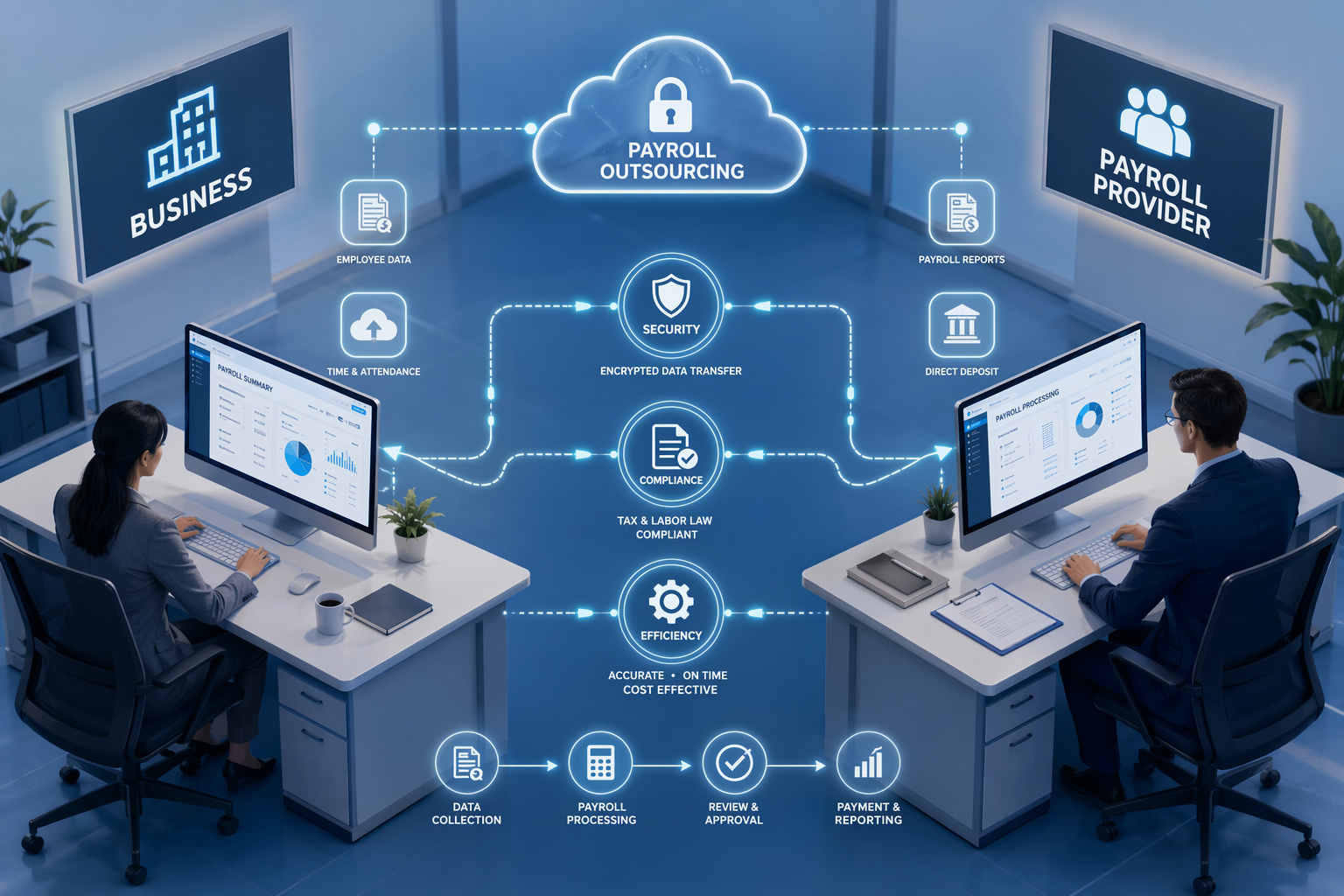
In simple terms, payroll outsourcing works by shifting payroll tasks from your payroll team to a payroll provider. The provider uses payroll software and structured payroll operations to process employee data, calculate pay, handle payroll records, and support payroll compliance. You still supply accurate information and approve what needs sign-off.
The setup can cover a few payroll functions or nearly the full payroll process, depending on your number of employees and business needs. Many payroll services also connect employee benefits, reporting, and payroll solutions into one system to improve payroll accuracy and employee satisfaction. Here is the typical workflow and how it fits with your current tools.
Standard Payroll Outsourcing Workflow
A standard payroll outsourcing workflow is usually straightforward. Your payroll team or payroll department provides current employee data, hours, pay updates, and other payroll records. Then the payroll provider uses payroll software to run the payroll process and complete required payroll tasks for each pay cycle.
A typical payroll workflow includes:
collecting employee records and pay inputs
processing wage calculations and deductions
reviewing payroll data for payroll accuracy
issuing payments and related payroll services outputs
preparing records and reports for the business
After that, the provider may also support tax work, reporting, and compliance checks, depending on the package. Whether you work with a payroll bureau or a payroll services company, payroll experts and payroll solutions help keep payroll operations organized. Some providers also use a payroll assurance scheme or similar review steps to reduce avoidable issues. Integration with existing systems is the next piece of the puzzle.
Integrating Payroll Outsourcing with Existing Systems
Payroll outsourcing works best when it connects smoothly with your existing systems. Many providers integrate payroll software with time tracking, benefits, and other HR tools so payroll data moves with less manual effort. That helps payroll management stay accurate and reduces delays in the payroll workflow.
Useful integration areas often include:
employee records flowing from HR files into payroll services
employee benefits deductions syncing with payroll administration
payroll data sharing with reporting and accounting tools
data security controls for sensitive employee data across systems
This setup can reduce duplicate entry and give your payroll department better visibility. A payroll services company, payroll bureau, or other payroll experts may also use a payroll assurance scheme to check data before final processing. When payroll operations connect well, employee satisfaction often improves because pay and deductions are more consistent. Compliance is another major reason integration matters, especially in Bangladesh.
Compliance & Regulatory Considerations in Bangladesh
Payroll compliance becomes more challenging as rules, filings, and employee requirements grow. For business owners in Bangladesh, payroll outsourcing can help organize payroll management around tax regulations, labor law needs, payroll records, and recurring tax obligations. That is especially useful when your payroll department is already stretched.
A capable payroll provider brings compliance expertise, payroll software, and structured payroll operations to each pay cycle. Good service providers also help manage employee data and sensitive employee data with greater care. To see where this support matters most, start with tax and NBR-related obligations, then move into labor law and employee benefits.
Local Laws, NBR Compliance & Tax Obligations
Staying current with tax laws and tax obligations is one of the hardest parts of payroll compliance. Payroll mistakes do not just create rework. They can also trigger penalties and disrupt payroll management. That is why many business owners rely on a payroll provider or payroll services company for better oversight.
Compliance support usually helps with:
tracking payroll data needed for tax filing and reporting
maintaining payroll records and employee records in an organized way
applying compliance monitoring during the payroll process
using payroll software to reduce manual mistakes
supporting accurate handling of employee benefits deductions where relevant
A payroll bureau or other payroll experts can make recurring requirements easier to manage, even though the employer still needs to provide correct information. Some providers also build in a payroll assurance scheme to check outputs before final submission. Tax rules are only one side of compliance, so labor law and employee support matter just as much.
Labor Law, Employee Benefits & Social Security
Payroll outsourcing can also support labor law requirements tied to pay, deductions, and employee treatment. When payroll records and employee data are handled correctly, your payroll management becomes more reliable and your payroll team has less manual work. This can improve employee satisfaction because pay and deductions stay more consistent.
Areas where support may help include:
aligning payroll administration with labor law requirements
managing employee benefits deductions through payroll software
keeping payroll records accurate across each pay cycle
improving the employee experience through dependable payroll services
A payroll provider or payroll bureau with compliance expertise can bring structure to payroll operations and routine checks through a payroll assurance scheme. Payroll experts can also help businesses handle employee benefits and related processes with fewer disruptions. Even so, outsourcing is not risk-free, so it is important to understand the challenges before choosing a partner.
Risks & Challenges of Payroll Outsourcing
Payroll outsourcing can reduce workload, but it does not remove every challenge. You still need a dependable payroll provider, accurate inputs, and clear payroll responsibilities. If employee records or payroll data are incomplete, problems can carry through the payroll process even when payroll services are handled externally.
The main concerns usually involve data security, sensitive employee information, service quality, and the risk of errors. That is why payroll management should include careful provider checks and internal oversight. The two biggest areas to watch are confidentiality and quality control, which we cover next.
Data Security and Confidentiality
One of the biggest questions about payroll outsourcing is whether your information stays safe. That concern is valid because payroll data includes employee information, pay details, tax data, and other sensitive employee data. A reputable payroll provider should treat this as a core part of payroll management, not an extra feature.
Look for strong protection such as:
secure payroll software and controlled access to payroll records
clear security measures for employee records and payroll data
backup systems and reliable storage practices
careful handling of data during payroll operations
experienced payroll experts who follow defined processes
Good controls reduce the risk of errors and help protect confidentiality across the payroll process. Whether you use a payroll bureau or broader payroll services, your payroll department should still understand how data moves and who can access it. Security matters, but accuracy matters just as much, especially when mistakes can affect trust and pay.
Ensuring Payroll Accuracy & Quality Control
Payroll accuracy depends on more than software alone. Even strong payroll services need a clear review process, reliable employee data, and defined payroll responsibilities between your business and the payroll provider. When those pieces are weak, costly mistakes can still happen.
Quality control should include:
checking employee data before each payroll process
reviewing wage calculations and payroll records before release
using a payroll assurance scheme or similar approval step
confirming who owns each part of payroll management
A payroll bureau or other payroll experts can improve payroll operations, but your payroll department still needs visibility. Good payroll solutions combine payroll software with human review so payroll functions stay consistent. That protects employee satisfaction because people are paid correctly and on time. Once you know the risks, selecting the right provider becomes much easier.
How to Select the Right Payroll Outsourcing Provider
Choosing a payroll provider is not only about price. The right provider should match your payroll functions, payroll process, and business size. Small businesses may need simple payroll services, while larger teams often need deeper payroll management, payroll software integration, and support for employee benefits.
It also helps to compare service providers based on payroll experts, reporting, and how they handle payroll data. A strong partner should fit your number of employees today and still support future growth. To make a smart choice, review core evaluation criteria first, then consider customization and local knowledge.
Top Criteria for Provider Evaluation
A good selection process starts with practical questions. Can the payroll provider handle your payroll process accurately? Do they offer the payroll services your team actually needs? The right provider should support daily payroll management while reducing pressure on your payroll department.
Focus on criteria such as:
experience with businesses like yours, especially small businesses if relevant
reliable payroll software and clear access to payroll records
payroll experts who can explain payroll operations clearly
payroll solutions that support employee benefits and reporting
quality checks such as a payroll assurance scheme or similar review method
Business owners should also ask how employee data is collected, updated, and protected. A payroll bureau may be enough for standard needs, while a payroll services company may be better for broader payroll functions. Once the basics are covered, the next question is whether the provider can adapt to your business model.
Customization, Localization, and Industry-Specific Expertise
The right payroll provider should not force every client into the same model. Businesses differ by size, pay structure, employee benefits, and internal workflow. That is why customization and localization matter in payroll outsourcing. A provider should be able to shape payroll solutions around your payroll process rather than the other way around.
Look for flexibility in areas such as:
payroll services that fit your number of employees and growth plans
localization support for local rules, practices, or reporting needs
payroll software that matches your payroll department workflow
payroll experts who understand your industry and employee records needs
This is especially useful for small businesses that need practical support without extra complexity. A payroll bureau or payroll services company with a payroll assurance scheme can also improve employee satisfaction by keeping payroll operations stable and consistent. With the provider question covered, it is time to wrap up the main takeaways.
Conclusion
In conclusion, outsourcing payroll services is a strategic move for businesses seeking to enhance efficiency, ensure compliance, and focus on core operations. By entrusting payroll management to specialized providers, companies can not only save time and reduce costs but also access expertise in navigating the complexities of local labor laws and tax regulations, particularly in Bangladesh. This approach helps mitigate risks associated with payroll processing, such as data security and accuracy issues. As you consider the myriad benefits of outsourcing, remember that a knowledgeable payroll provider can be a valuable partner in driving your business's success. If you're ready to take the next step towards streamlined operations, don't hesitate to reach out for a free consultation today!
Frequently Asked Questions
What are the cost savings associated with outsourcing payroll services?
Cost savings from payroll outsourcing usually come from reduced admin time, fewer corrections, and lower risk of penalties. A payroll provider can also cut the need for extra software or added internal payroll management effort. For many businesses, payroll services create savings by improving efficiency, not just by lowering direct costs.
How can outsourcing payroll improve the accuracy of my business's payroll processing?
Payroll outsourcing improves payroll accuracy by combining automation with expert review. A payroll provider uses structured payroll management processes, reliable systems, and repeated checks to reduce manual errors. Good payroll services also keep records organized, which helps prevent mistakes in calculations, deductions, and employee pay.
What should I look for when choosing a payroll service provider?
Look for a payroll provider with strong support, clear pricing, dependable payroll management, secure systems, and experience with businesses like yours. The right provider should offer payroll services that match your size, workflow, and reporting needs, while also showing a reliable process for accuracy, compliance, and data protection.
Are there any compliance benefits to outsourcing payroll services?
Yes. Payroll outsourcing can improve payroll compliance by helping businesses keep up with tax rules, filing requirements, and routine reporting. A capable payroll provider brings more structure to payroll management and often monitors changes that internal teams may miss. That support helps reduce avoidable mistakes and late filings.
How does outsourcing payroll impact employee satisfaction and engagement?
A reliable payroll provider can improve employee satisfaction by helping ensure people are paid correctly and on time. Payroll outsourcing also supports smoother deductions, better record access, and fewer paycheck issues. When payroll management is consistent, employees spend less time chasing answers and have a better overall experience.
What are the cost savings associated with outsourcing payroll services?
Beyond direct labor reduction, cost savings often come from fewer payroll errors, less rework, and lower exposure to fines. Payroll outsourcing also helps businesses avoid spending too much internal time on repetitive tasks. A payroll provider can make payroll management more predictable and payroll services easier to budget over time.
What types of businesses benefit most from outsourcing payroll services?
Small businesses often benefit the most because they may not have a dedicated payroll team. Still, growing companies, multi-location employers, and firms with complex reporting can gain value too. Payroll outsourcing helps when payroll management becomes too time-consuming or risky for internal staff to handle alone.
How can outsourcing payroll improve accuracy and compliance for my business?
Payroll outsourcing supports payroll accuracy through automation, expert review, and better recordkeeping. It also strengthens payroll compliance because a payroll provider usually tracks filing needs, deadlines, and changing requirements more closely. With stronger payroll management, businesses reduce errors and gain more confidence in each payroll cycle.
What should I look for when choosing a payroll service provider?
The right provider should offer secure systems, responsive support, clear workflows, and payroll services that fit your business size and complexity. Ask how they handle approvals, corrections, and reporting. A strong payroll provider should make payroll management easier while giving you visibility and confidence in the process.
What are the primary benefits of outsourcing payroll services for small businesses?
For small businesses, payroll outsourcing saves time, lowers admin pressure, and reduces the chance of costly mistakes. A payroll provider can also bring tools and expertise that would be expensive to build internally. This makes payroll management simpler while helping payroll services stay consistent as the business grows.
Are there any risks associated with outsourcing payroll services, and how can they be mitigated?
Yes. The main risks involve data security, service quality, and unclear responsibilities. You can reduce them by choosing a trusted payroll provider, confirming their controls, and keeping internal review steps in place. Strong payroll management and clear communication help payroll services run smoothly without losing oversight.
What factors should a business consider when choosing a payroll outsourcing provider?
A business should consider service scope, system reliability, support quality, pricing clarity, and fit with internal processes. The right provider should also handle growth well and show experience with your payroll needs. Good payroll outsourcing works best when payroll management responsibilities are clearly shared and documented.
How can outsourcing payroll help reduce administrative costs?
Outsourcing payroll streamlines processes, minimizing the need for in-house staff and reducing overhead costs. By leveraging expert services, businesses can avoid costly errors and compliance issues, ultimately saving time and money that can be redirected toward core operations and growth initiatives.


Comments
Post a Comment